... if we do discover a complete theory, it should in time be understandable in broad principle by everyone, not just a few scientists. Then we shall all, philosophers, scientists, and just ordinary people, be able to take part in the discussion of the question of why it is that we and the universe exist. If we find the answer to that, it would be the ultimate triumph of human reason - for then we would know the mind of God.

Stephen William Hawking

Conclusion at the end of his book A Brief History of Time

Hawking.jpg


Theory of Analytical Space-Time ( I )

Author:  Cui Silong    PhD

Next Chapter

Download PDF version

Introduction

This is a new and fundamental theory of physics established on two hypotheses as principles: The area of space-time is invariant (Principle of a string) and any two coordinates with relative speed would deflect each other. The theory completes Lorentz transformation with a factor of two-dimensional or multi-dimensional rotation, obtains a new expression of astro-body precession angular speed, gives two forecasts, demonstrates Schrödinger equation with space-time rotation and concludes a space-time wave panorama for Newtonian space, Relativistic space, quantum space and black-holes. These webpages show the course of the basic math expressions that include or unify the foundations of Special Relativity, General Relativity and Quantum Mechanics.

The format of this course is not only for professional people but also for those who are interested in theoretical physics. All references can be found in university physics textbooks.


What humans initially studied about the frame of space-time in science began in 1905 when the Special Theory of Relativity (STR) was established. STR first pointed out that observers of any two different coordinates who described "an event" such as time and space would get different results, which represented a breakthrough of the knowledge of space-time in human history. STR has opened out the relation among space, time and motion. Having put gravitational field and space-time geometry together, Einstein later set up General Theory of Relativity (GTR), which brought about an argument that all substantial movement was related to gravitational field and that we lived in a space of Riemann. Some experiments made by scientists in recent decades have shown that the judgements of GTR are correct. All of us esteem the profound thinking by Einstein in learning and studying Theory of Relativity and appreciate his contribution to modern physics.

As for development and innovation of theory of time-space, it is a pity that since the establishment of GTR, although study on space-time has made some progress in quantum theory, we are still puzzled with the complicated problems of space-time frame. What is more perplexing, up till now, is that we do not know much about the foundation of the "Space-time edifice".

After years' study, we have found that the Theory of Relativity has described only a part of space-time and that Lorentz transformation even has theoretical defects, and we can not get right answers on the issues of space-time frame based upon the Theory of Relativity only:

  1. What is the physical meaning of the contraction factor 1_1.gif  in STR?
  2. In Lorentz transformation, on what basis is the judgement of y = y' and z = z' (y and z are orthogonal to relative velocity)?
  3. Is there possibly another theoretical explanation for red shift?
  4. Whether do observers of two different coordinates get the same result in describing relative velocity, or not?
  5. Mercury orbital perturbation is due to its movement along a shortest route (geodesic) on bent space, then, how does gravitation make space bent? What is the essential reason for the phenomenon?
  6. Is there a general solution for gravitational equation of metric tensor (guv.gif (896 bytes)) and under what condition is the solution unique?
  7. Assuming that a train moves forward at a high speed v1, an automobile on the train moves at speed v2 relative to the train, and, in the meantime, an object is cast from the automobile at speed v3 relative to the automobile, how to express the movement of the object? If the automobile moves in acceleration and the cast object moves at an angle b  from the direction of v1 or v2, then how could its movement equation be set up?

Obviously, the explanations for all the questions above are beyond what the Theory of Relativity concerns. In order to get right answers, we have to build a new space-time system to surpass the range of Relativity extensively, summarize different states of space-time and make the Theory of Relativity a special case of the new one and finally include quantum mechanics seamlessly.

We now introduce a  new space-time theory to you:


Chapter 1

Establishment of Theory of Analytical Space-Time (TAST)

1.1 Foundation of the theory

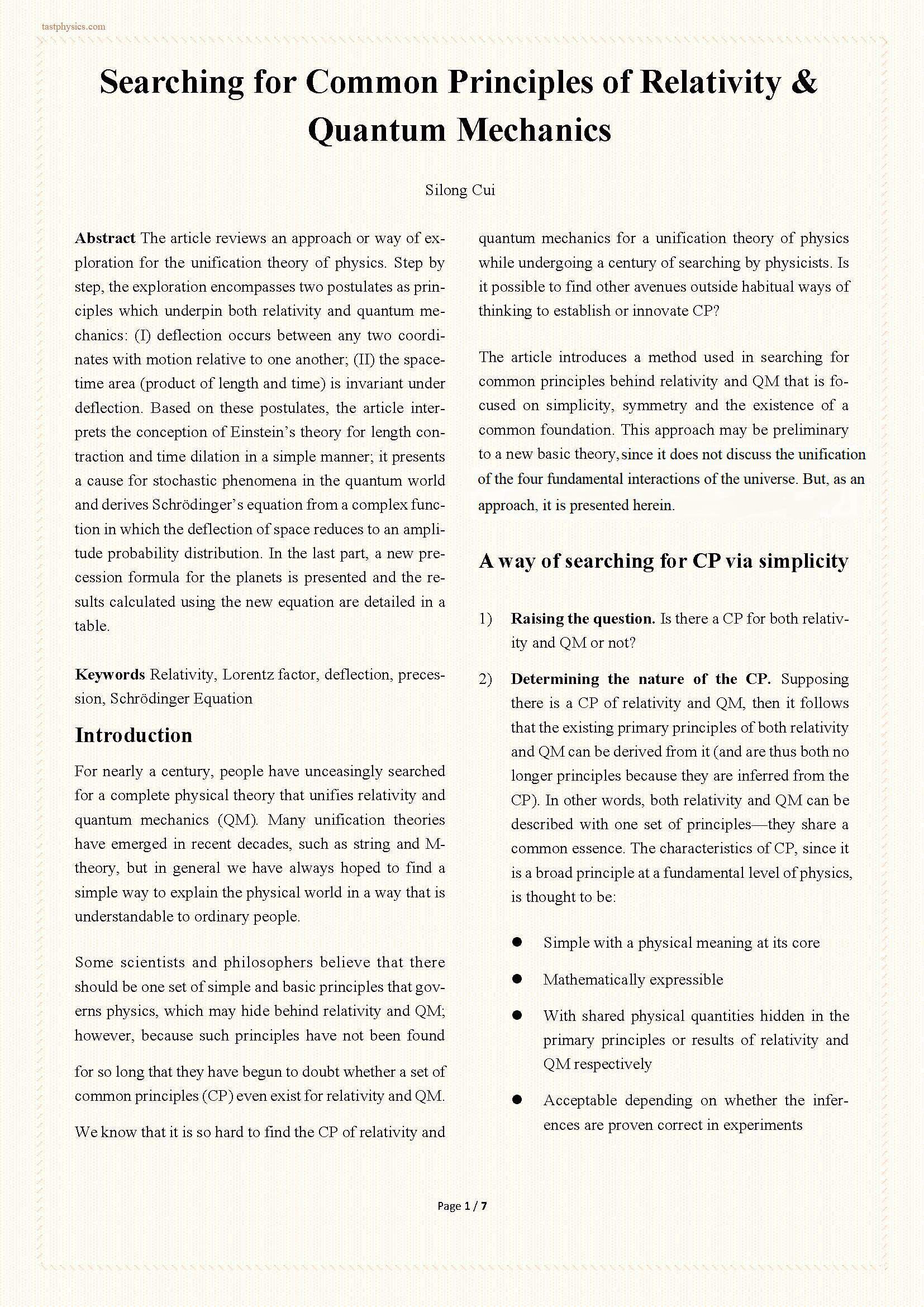
Definition: Given two right-angled coordinates (S') and (S), (S') is the moving coordinate and (S) is the observing coordinate. l' and t' in (S') indicate length and time upon the condition that (S') is in a stationary state relative to (S). If there is a relative motion between (S') and (S), we, being in (S), measure l ' and t' in (S'). The result of measurement is l and t, so l and t are all measured data.

Two hypotheses for TAST:

(I) Principle of invariant space-time area (Principle of a string)-- Product of length l' and time t' in (S') and product of l and t in (S) are called space-time area S' and S respectively. The space-time area is invariant whether there is a relative motion between (S') and (S) or not. For any (l', t'), it must meet the equation:    l' t' = l t

What is said above can be stated in analytical geometry: If there is one point (l1', t1') in (S'), there must be at least another point (l1 , t1) in (S) that makes the equation

l1' t1' = l1 t1 tenable, see Fig 1-1.

fig1-1

(II)  Principle of space-time deflection --  if a moving coordinate (S') leaves or approaches the observing coordinate (S) with speed u (or u'), (S') deflects (S) from the direction of u (or u'), and the angle q of deflection or rotation results from the relative motion and its sine is proportional to relative speed u.

Therefore

sinq=u/c or sinq=u'/c'   (c is speed of light.)

Fig. 1-2 shows the deflection between (S') and (S) when both origins of the coordinates coincide.

fig1-2

According to principles (I) and (II), we can find the space-time relation between (S') and (S):

Given that the origins of (S') and (S) coincide, see Fig. 1-3, the relative speed is u, and that l is in the same direction as u, as per principle (II), the deflection between (S') and (S) occurs:

fig1-3

We get the results from Fig. 1-3:

OD = OAcosq

Let OD = l and OA = l',

then l = l'cosq                                (1-1)

And from principle (I), space-time area S'ABCO equals to SDEFO ,

so       t l= t'l' ,  t = t'(l'/l),

then substituting formula (1-1) for above,
we get     t = t'/ cosq                    ( 1-2 )

And with principle (II): sinq =u/c,

f1 

then (1-1) and (1-2) are as follows:

f2


Figure 1-3 shows the expression cosq  = l/l' =t'/t, in which the q is just the q in principle (II) sinq =u/c. Formulas ( 1-3 ) and ( 1-4 ) are the basic equations of STR. Here we know that there is a definite meaning of the contraction factor: the deflection factor of space-time. It is the deflection or rotation of space-time that causes the contraction of a moving ruler and the delay of a moving clock.

The speed relation between (S') and (S) is as follows: (non-coordinate relation)

According to formula ( 1-1 ):   l = l' cosq,  

we take l1 and l2      (l1¹ l2)

then l1 = l'1cosq and l2 = l'2cosq

l2- l1= (l'2- l'1) cosq

D l21= D l'21 cosq                       (1-5)

When D l21®0

dl =dl'cosq                                  (1-6)

In the same way, from formula (1-2 ) we can get:

dt =dt'/ cosq

dt'/dt = cosq            (1-7)

so in formula (1-6), differentiating time t

dl/dt = cosq dl'/dt

substituting formula (1-7) for above

f3.gif (1270 ??)

dl/dt = cos2q dl'/dt'

\ u = u'cos2q                      (1-8)

when u and u' are in opposite direction,

u= -u'cos2q                         (1-9)

Formulas (1-8) and (1-9) indicate that speed u in (S) corresponds to speed u' in (S') when there is a relative motion between (S') and (S).

1.2  Coordinates transformation

As stated at the beginning of this Chapter that there are theoretical incompleteness in Lorentz transformation, the discussion on what kinds of defects there are in Lorentz transformation is as follows:

It is known that the following two formulas (1-10) and (1-11) are basic equations of Lorentz transformation and all results are derived from the joint equations of formulas (1-10) and (1-11):

f4

Formula (1-11) is a result of exchanging the variables with a prime ( ') with the variables without a prime in (1-10) and u = -u'. In textbooks, u is generally substituted with -u. Lorentz transformation never explains why u = -u' because all of us think u = -u' is a common sense.

It seems no problem at all on above equations, however we write down the two equations like this:

f5

where

f6

Multiplying ( 1-13 ) by cosq and rearranging the two equations:

f7

substituting formula ( 1-2 )   t'= t cosq   for (1-15), and (1-14) minus (1-15)

then ut-ut cos2q = x-x cos2q

ut(1- cos2q ) = x(1- cos2q)

therefore x = ut or t = x/u

This is the solution of above equations, however it is useless to us. We can also get some other solutions including Lorentz transformation from joint equations (1-10) and (1-11).

Applying mathematical method of the system of linear equations, we find the rank of the equations is less than its dimension, i.e. r < n. So there are unlimited solutions for joint equations (1-10) and (1-11). Therefore, the completeness of Lorentz transformation may be doubtful. After careful analyses, a definite conclusion is worked out:

As for the issue of relative velocity, we have to give a further explanation here. For example,  if one train moves at speed 80 km/h, two observers, one on the train and the other on the ground, deem it is the relative speed between the train and ground. But things is not as simple as we think to be. We may set up a coordinate on the ground so the train moves away at speed of 80 km/h, and we also set up a moving coordinates on the train. The observer on the train says that the station on the ground retreats at speed of 80 km'/h'. The key point here is whether m/h equals m'/h', or not? i.e. Are the ruler and clock on the train to measure the speed equal to those on the ground? Because we live in a low-speed world, we feel no difference on velocity in different coordinates and we can't find a coordinate at so high a speed that it could make us tell this difference. Comparing to light speed, the physical speed around us is very small, so we unconsciously get the conclusion u = -u' which indicates that observers both on the train and on the ground use the same scaled ruler and clock. Absolutization of relative velocity is obviously the product of low-speed-thinking. Actually, with Lorentz transformation, we have been aware that it is inapplicable to simply use resultant motion ( va = ue + vr') when drag velocity ue is not much lower than light speed. On the issue of drag motion, Lorentz transformation does not totally cast off the conception of low-speed-thinking because of the fact that it is more difficult to imagine why u ¹ -u'. In general, observers of different coordinates who describe "an event" such as time, space (including point), velocity, acceleration, etc. will get different results. There are no absolute time, space, velocity and acceleration (or anything), nor is drag motion. Since drag motion is a velocity u measured in a coordinate (S), why must it be equal to u' that is measured by the observers of a moving coordinate (S')? Why do we give drag motion such a preferential treatment of absoluteness? The conclusion we have here is because the moving coordinate (S') deflects the observing coordinate (S), and not only do we realize that time and space have been changed, but also space-time actually deflects them all. We have to admit that 'relative velocity' u and u' have different directions of their own, so it needs to add a deflection coefficient cos2q to link u' to u. (i.e. u = u'cos2q). Another important reason to explain why u ¹ -u' is its physical dimension. Since u and u' have different unit dimensions or derived units (m/s , m'/s'), how can we make them equal to each other without converting their units?

We should rectify Lorentz transformation (1-12) and (1-13) as follows:

x = ut + x' cosq                                 (1-16)

x' = xcosq + u't'                                  (1-17)

From ( 1-17 ),  we get:    x = (x' - u't')/cosq

substituting above for (1-16)

then  t = (x'sin2q -u't') / ucosq

differentiating x and t

dx = (dx'-u'dt') / cosq

dt = (dx'sin2q -u'dt') / ucosq

e13

From (1-9): u = -u'cos2q

and with principle(II): sinq = u'/c',

substituting them for above formula:

e14

From formula (1-18) we can see: When u= - u' and cosq =1, we'll come back to Lorentz transformation, which is an approximate expression of formula (1-18).

From (1-18), we get equation about v'

e15

Formulas (1-18) and (1-19) look like Lorentz transformation, but they indicate more information. For instance, when relative speed u' equals to light speed and  space-time reflects by 90 degree (cosq =0), we can see nothing moving in (S') including light.  In this case, (S') is obviously the state of 'black-hole'' so-called 'singular point' of space-time.

Now let us study coordinate transformation of (S') and (S):

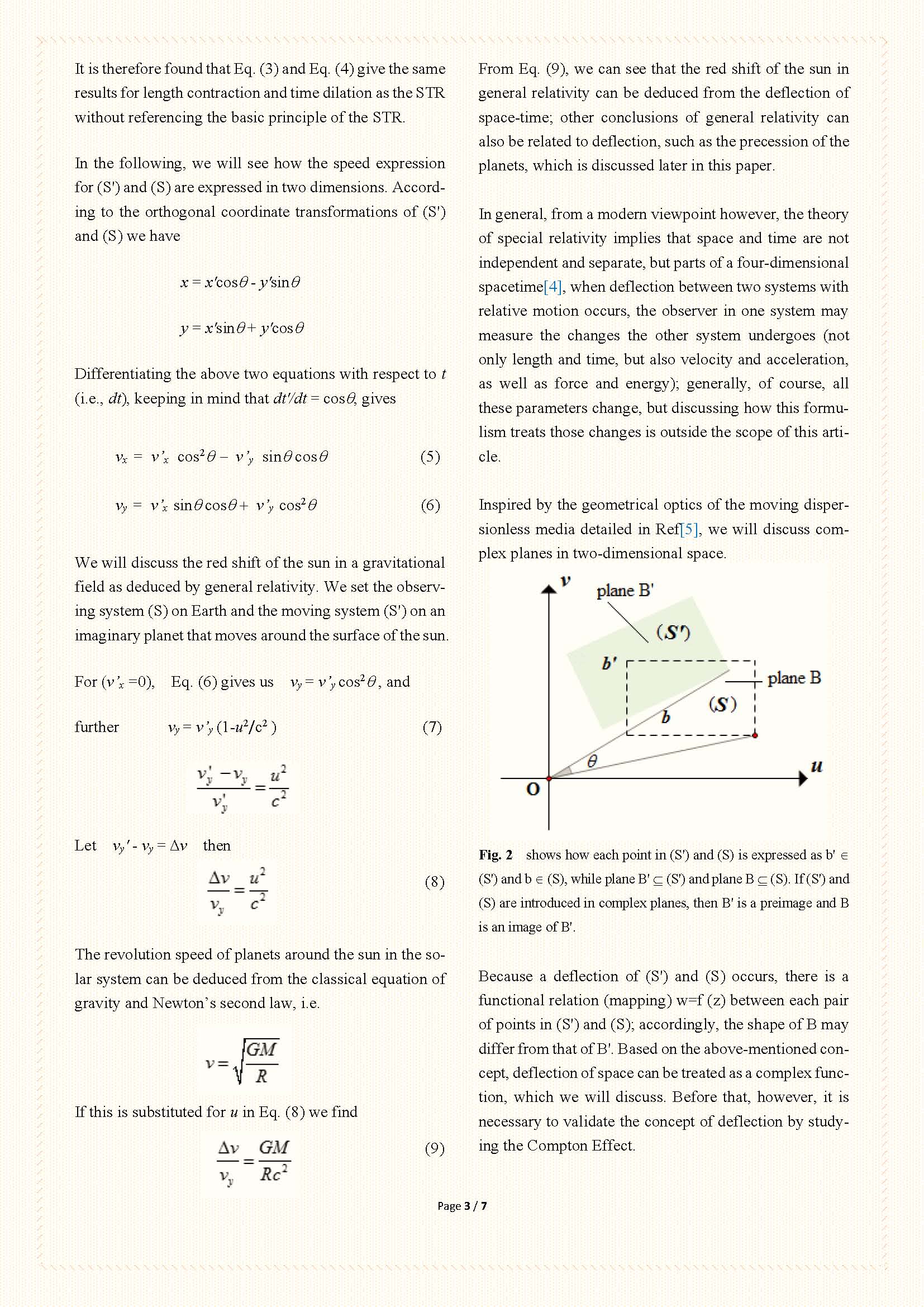
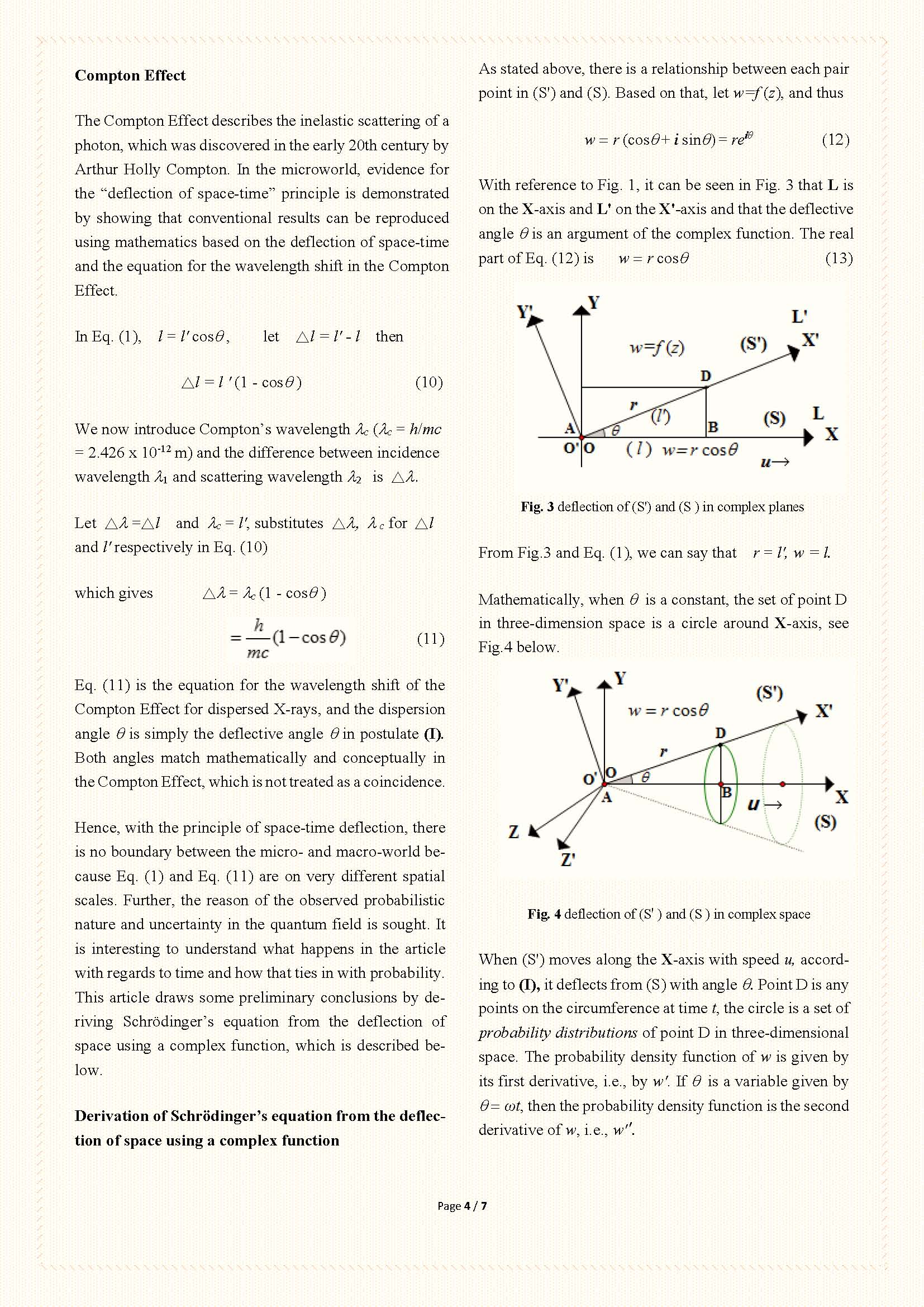
When there is a relative speed between (S') and (S), u and y are in the same direction, and let both origins coincide, according to principle (II), (S') deflects from (S) and the space coordinates (o-xy) and (o'-x'y') deflect each other by an angle q, see Fig 1-4. As for the rotating formula of right-angled coordinates:

fig1-4

x = x'cosq -y'sinq                             (1-20)

y = x'sinq+ y'cosq                           (1-21)

(1-20) and (1-21) are space expressions of (S') and (S).

In (1-21), let x' = c't', with principle (II) sinq = u'/c',

then      y = y'cosq + u't'

f8


If we change y, y' into x, x' in (1-22), the formula will be the same as Lorentz transformation formula (1-10). The only difference between both is the description of relative space or distance of both origins.

As you may note x ¹ x' in (1-20), it means the length orthogonal to velocity u will change along with the relative speed. In Lorentz transformation, y = y', z = z' (Where x is identical to y and z and all of them are orthogonal to u.) is also not correct, because it is based on our daily experiences and lack of theoretical foundation.

Lorentz transformation does not deal with the concept of deflection though it indirectly uses the rotation concept in formula (1-10). To normalize space-time frame, we conclude that Galilean transformation is zero-dimensional rotation (non-rotation) and that Lorentz transformation belongs to one-dimensional rotation, whereas TAST includes two-dimensional or multi-dimensional rotation. Especially in a high speed, Galilean transformation is inapplicable and we should not use the concept of 0.9c + 0.9c to express this case in Lorentz transformation because of space-time deflection effect. In this case, the velocity in the moving coordinate (S') would be 0.9c', which is far lower than 0.9c in original direction.

On the following, we will get speed expression of (S') and (S) in two dimensions:

From formulas (1-20) and (1-21):

x = x'cosq - y'sinq

y = x'sinq + y'cosq

differentiating above two formulas:

e17

and differentiating t:

e18

e19

with  dt'/dt = cosq,    then

e20

Formulas (1-22) and (1-23) are speed expression of two-dimensional rotation, which is demonstrated by way of geometry. Now we confirm it again with the method of vector.

Supposing radius vector of (S):      f9.gif (1052 ??)

Radius vector of (S'):         f10.gif (1270 ??)

With formula (1-5):  

Dl21=Dl'21cosq

f11.gif (1070 ??)

 It can be written like this:         f12.gif (994 ??)

f13

(Derivation of above formulas refers to the unit vector differential coefficient formula.)

f14

We see that the result above is the same as formulas (1-23) and (1-24).

TAST tells us that light speed is the speed limit to the show of what we observe instead of to how it is really moving! This conclusion is deferent from the assertion by STR that light speed is the limit of motion of anything.

We can not fix the direction of the deflection by observing an object at very high speed and this is related to quantum uncertainty and non-locality. Please refer to next Chapter. Space-time deflection or rotation may help us clarify our perplexing concepts among observation, measurement, objective, subjective, phenomena, reality and existence in physics in the end.

1.3  TAST  for non-inertial system

With the two principles, we have discussed the expression of space-time in the scope of STR. In non-inertial system, however, when relative speed becomes variable, the principles (I) and (II) are still applicable. Accordingly, it is necessary for us to refer to GTR. Though the issue of gravitational field is only a part of non-inertial system, we emphasize it as a major study:

1.3.1  Red shift of the sun and other stars

It is known that the revolution speed of planets round the sun in the solar system can be educed from the Law of Gravity and the Second Law of Newton:

f15

MS: mass of the sun

R: distance between a planet and the sun

Supposing planet XS goes round the sun, its speed will be:

f16

Rs: radius of the sun

vs: non-locus speed of the planet

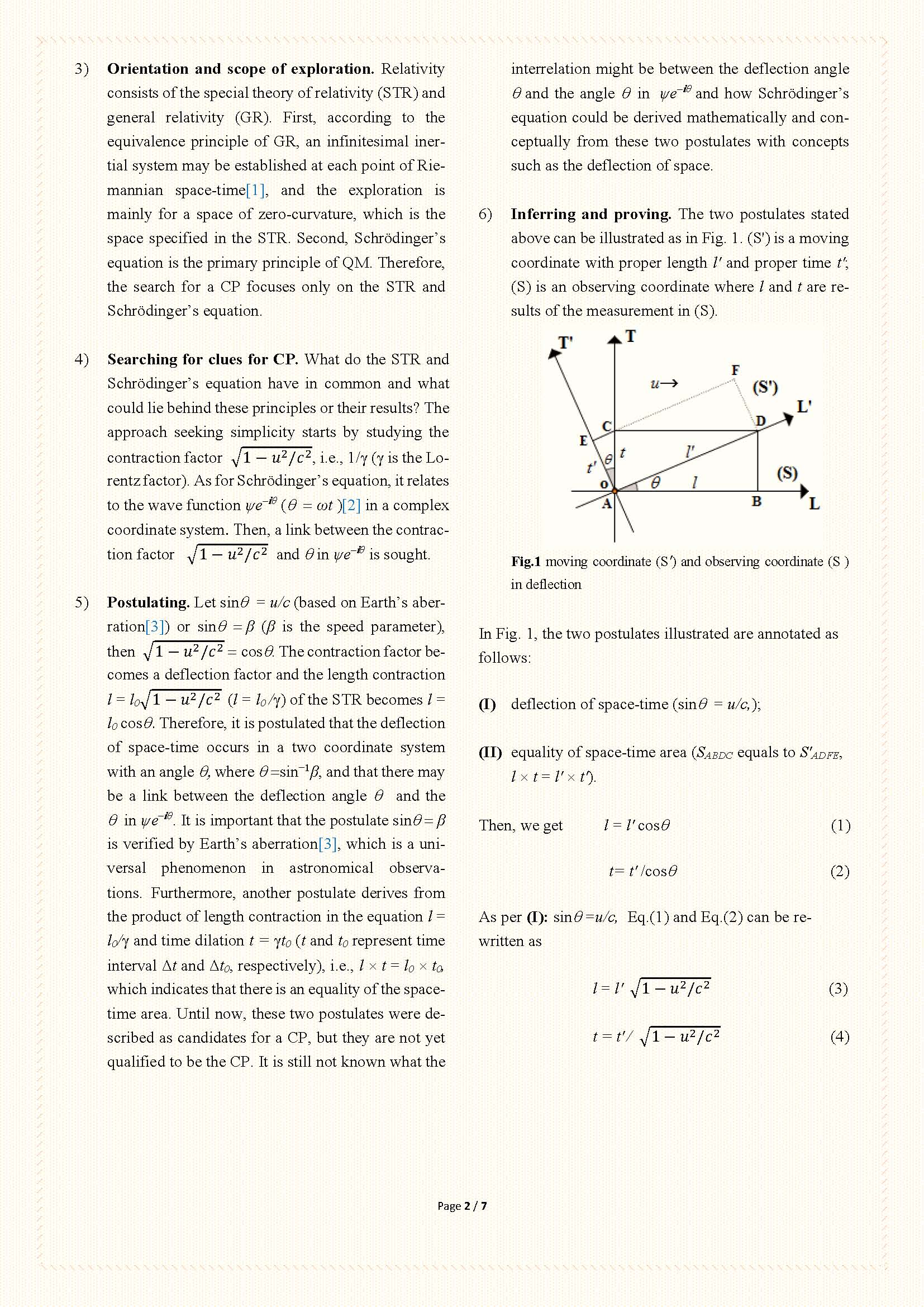
If we set the observing system (S) on the earth and the moving system (S') on planet Xs, (S') has a relative speed u to (S), and u=vs .

According to formula (1-24):

f17.gif (2198 ??)

Let   vy' - vy = Dv

Dv means the speed difference for a velocity described by (S') and (S).

f18.gif (1061 ??)

And let vy' = c,  then  Dv = Dc

f19.gif (1757 ??)

Where v and l are frequency and wavelength of light respectively.

f20.gif (1467 ??)

Formula (1-26) is the same as that in GTR about red shift and its calculated value is:

e31.gif (332 bytes)

Formula (1-26) indicates that red shift would be much bigger if the density of a star is very great. This means red shift is also related to the density of stars. The factor that influences red shift is beyond Doppler effect.

1.3.2   Light 'bent' in gravitation field

Light would curve in gravitational field -- The prediction by GTR was demonstrated in experiments. We now reconfirm it with TAST:

From formula  (1-25):

e32.gif (215 bytes)

Let sina =Dc/c, angle a is the deflection of light:

f21.gif (1244 ??)


We can get the deflection angle of sun-light with formula (1-27):

f23.gif (1079 ??)

When as is very small,

f22.gif (1099 ??)

Since as is too small to observe, we survey the deflection of another star when eclipse occurs. If the star we observe is similar to the sun in stability and approximately as dense as the sun, the light of this star would deflect as shown in Fig. 1-5.

fig1-5

f24.gif (1527 ??)

With formula (1-27)

f25.gif (1069 ??)

and  u = vs + vx

f26.gif (2250 ??)

The deflective angle ax is not merely caused by solar gravitation and actually it is the sum of deflective angle of the sun and the star and caused by the sun-star system that has a non-locus speed (u = vs+ vx ) relative to observers on the earth. It should be said that the essence of 'light bent' is light deflection indeed. Formula (1-29) is the approximation of (1-28). For a white dwarf, its deflection angle can be figured out with formula (1-28).

1.3.3 Mercury orbital perturbation

General Relativity has given out the expression of perihelion precession of mercury by Schwarzschild solution and solved the surplus precession of Mercury orbit:

f27.gif (1308 ??)

The following formula (1-30) is derived from TAST (The course is skipped here.) and the calculation result meets the real facts.

f28.gif (2772 ??)

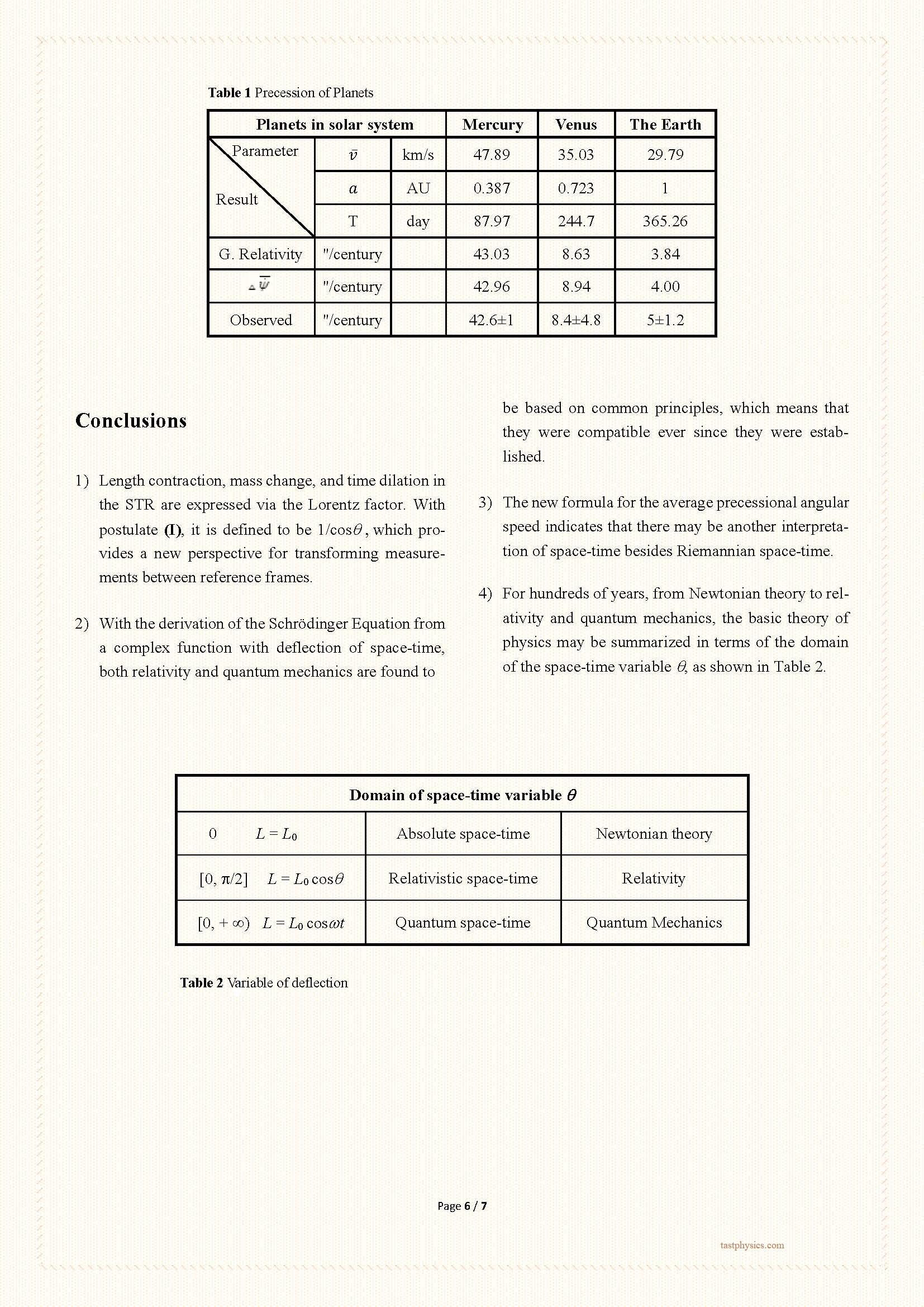
With the formula (1-30), we can figure out the precession angular speed of Mercury orbit to be 43.08" per century. It can be also used to calculate the precession angular speed of Venus, the Earth and other planets.

Apart from planetary orbital perturbation in solar system, there are other perturbation phenomena in binary-star system. Two astronomers, E. F. Guinan and F. P. Maloney, in Villanova University of USA in 1985 found that the accumulated precession angular of the binary star DI Her in 84 years was much lower than the calculated amount with GTR. Astronomers could hardly find out a fair explanation for the fact. We can use formula (1-30) to solve this problem, getting 0.66 degree, so closely matching 0.64 degree of the observed fact, compared with 2.34 degree calculated with GTR [Edward. F. Guinan and Frank. P. Maloney Astronomical Journal v 90 (1985) p 1519].

We have discussed red shift in GTR, Light bent in gravitation field and Mercury orbital perturbation. So far we have answered some questions mentioned at the beginning of this Chapter and  hope that you have briefly understood TAST.

Space-time frame is one of most important concepts in physics and all our basic physical concepts such as continuity, discrete, fluctuation and so on are established on it. We will discuss it as well as metric tensor (guv.gif (896 bytes)) in gravitational field of GTR in a later Chapter.

You may notice that the two principles (I) and (II) of the new theory do not deal with the basic principle of invariant light speed, but the results we have got are the same as those from GTR. Actually, it is the principles (I) and (II) that sum up the principles of general covariance and invariant of light speed and open out the inner-contact of space-time more widely and deeply.


1.4  Forecasts

As for the establishment of the new and fundamental theory, it is insufficient to demonstrate what have been concluded, we need to (or must) bring forward some new and unidentified inferences or forecasts as follows to confirm the correctness of the principles (I) and (II) .

1.4.1       0.71c space-time light cone vertex

From two-dimensional space-time expression (1-20),

x = x'cosq -y'sinq

let  x' = y' = c't'

then x = c't' (cosq - sinq)

and let x = 0 and t' ¹ 0

then cosq - sinq= 0 ; tgq = 1, q = p/4

f29.gif (1468 ??)

The result shows that x orthogonal to the leaving velocity u will become null when relative speed is 0.71c (q = 45 degree ). The significance of space-time here is that anything that has relative speed 0.71c to us is invisible even though it moves in front of our eyes. The object can appear again from its rear side when relative speed u > 0.71c. This forms a phenomenon of light cone whose vertex point is 0.71c and it may be demonstrated by measuring moving particles in lab.

It is an amazing fact referring to this inference: Anything, no mater how big or small, will have no barrier in space as long as it reaches the relative speed of 0.71c (or in a state of 45 degree of deflective or rotational angle of space)!

Ever thought about material or body fax?

1.4.2   Deflection of space-time results in double refraction of light

Under the deflection of space-time, we know that time, space, velocity, etc. would change. What about light then? Can we say light speed is unchangeable in vacuum?

We conclude that light from a moving system will produce a phenomenon of double refraction. Light will split into two rays: one is ordinary ray co and the other is extraordinary ray ce.

co spreads with the same speed in all directions and follows the law of refraction whereas ce goes with a speed that is changeable in different directions and varies on the relative speed of a moving system and does not follow the law of refraction.

Speed formula of extraordinary ray ce is as follows:

With (1-18),

f30.gif (1304 ??)

Let v' = c' represent the measured speed of light in (S'),

f31.gif (1767 ??)

Let c' = c, then

v = ccos2q                            (1-31)

Referring to formula (1-31), v is ce ;

then ce = ccos2q

ce = c(1-u2/c2)                          (1-32)

In formula (1-32), ce < c means not all light speed is invariant. This conclusion is challenging the principle of invariant light speed. Another thing we have to know is the angle between ce and co shown in formula (1-28) and Fig. 1-5.  In addition, ce does not show the event of red shift and co is always red shifted in spectrum.

The things left to us are to identify the existence of ce and see if ce is less than light speed c or not.

f32.gif (1221 ??)

(Under such a condition, observed ce should be 1/100000 lower than c. )

Besides u = -u'cos2q, the two forecasts above or other direct inferences from TAST will validate the principles (I) and (II), and at meantime they are a quite checkup for TAST, so we look forward to experimental results.

May 25, 1999

Now, let us go to Chapter 2 to see how TAST unifies Quantum Mechanics!


Copyright Reserved

Some printed campus versions of TAST are partly different from the web-version, please take this web-version as the authorized text.

Webmaster

Chapter 2

Download PDF version

Email